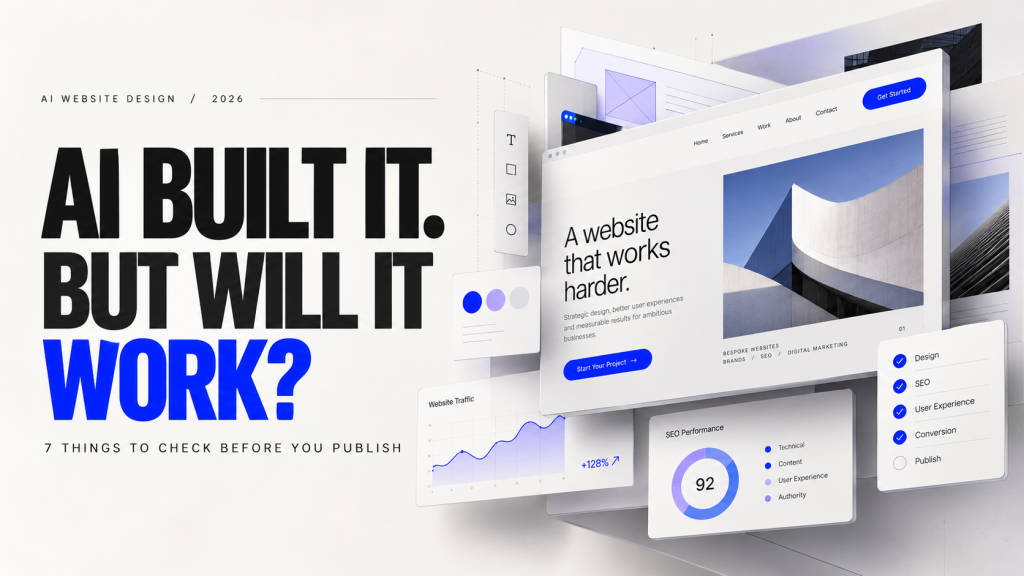
AI Website Builder vs Web Designer in 2026: 7 Things to Check Before You Publish
Building a website has never been easier. With an AI website builder, you can generate a complete website in minutes, often without writing a single line of code.
Sounds impressive, doesn’t it?
But here’s the real question: Just because AI can build your website, does that mean it can help grow your business?
In 2026, artificial intelligence is transforming website design. AI-powered platforms promise professional layouts, automated content, responsive designs and a faster route to getting your business online.
For startups and small businesses, these tools can be incredibly useful.
However, there’s a big difference between launching a website and creating one that attracts visitors, builds trust and generates enquiries.
Before investing your time and money in an AI-generated website, here are seven essential things to consider.
What Is an AI Website Builder?
An AI website builder is a platform that uses artificial intelligence to generate website designs, layouts, content and sometimes functionality based on your instructions.
Instead of designing every page manually, you describe your business, select your preferences and let AI produce an initial website.
Popular platforms such as Wix and Hostinger offer AI-powered website creation tools, making web design more accessible to people without technical experience.
These tools can help you:
-
Generate website layouts and page structures.
-
Create headlines and website content.
-
Suggest colours, imagery and typography.
-
Build basic contact forms.
-
Create mobile-responsive pages.
-
Generate SEO titles and descriptions.
-
Launch simple business websites quickly.
For a small business with a limited budget, this can be a practical starting point.
But there’s something important to remember.
AI can generate a website. It doesn’t automatically understand your business strategy, customer behaviour or what makes your brand different.
That’s where professional design expertise becomes valuable.
AI Website Builder vs Web Designer: What’s the Difference?
An AI website builder focuses primarily on generating a website.
A professional web designer focuses on creating an experience that supports your business objectives.
This difference matters more than you might expect.
Imagine you’re launching a new beauty salon.
An AI tool could quickly generate a homepage with attractive imagery, a services section and a contact form.
But would it know which treatments are most profitable? Which questions customers ask before booking? Or what information helps someone feel confident choosing your salon?
Not necessarily.
A professional designer can explore these questions before making decisions about layout, content, navigation and calls to action.
The goal isn’t simply to create a visually attractive website.
It’s to build something that helps people understand your services, trust your business and take meaningful action.
The most effective approach isn’t always AI versus human designers. It can be a combination of both.
AI can speed up repetitive tasks and early creative exploration, while human expertise provides strategic thinking, brand understanding and user-centred design decisions.
7 Essential Checks Before Launching Your AI Website
Whether you’ve already created an AI-generated website or are still exploring your options, this checklist will help you evaluate whether your website is ready to represent your business.
1. Does Your AI Website Builder Communicate Your Business Clearly?
One of the biggest weaknesses of unedited AI-generated content is generic messaging.
You’ve probably seen headlines such as:
“Transforming Ideas Into Excellence.”
Or:
“Your Trusted Partner for Innovative Solutions.”
They sound professional, but what do they actually tell customers?
Not much.
Imagine a Liverpool-based Pilates studio using this instead:
“Small-Group Pilates Classes in Liverpool. Build Strength, Improve Mobility and Feel Your Best.”
Immediately, the message becomes clearer.
Visitors know what the business offers, where it’s based and why they might be interested.
Try this simple test: Show your homepage to someone unfamiliar with your business for five seconds.
Can they explain what you do, who you help and what they should do next?
If the answer is no, your website messaging probably needs more attention.
2. Is Your AI Website Optimised for Google Search?
One of the most common questions about AI-generated websites is whether they can rank on Google.
The answer is yes.
Google doesn’t automatically penalise content simply because artificial intelligence was involved in creating it.
However, it places importance on useful, accurate, relevant and original content that benefits visitors.
Google explains this in its official guidance on AI-generated website content.
Before publishing your AI website, check whether it includes:
-
Relevant keywords used naturally throughout the content.
-
Unique SEO titles and meta descriptions.
-
Clear H1, H2 and H3 heading structures.
-
Descriptive image alt text.
-
Logical internal links.
-
Helpful, original content.
-
Pages accessible to search engines.
-
Mobile-friendly layouts and good performance.
Some AI website builders provide these features, but having access to SEO tools doesn’t guarantee that your website is fully optimised.
A visually impressive website that nobody can find on Google is unlikely to deliver its full business potential.
3. Is Your Website Content Based on Real Customer Searches?
AI can produce hundreds of words in seconds.
But more content doesn’t automatically mean better SEO.
Search engine optimisation starts with understanding what your potential customers are actually searching for.
For example, someone looking for a solicitor in Liverpool might search for a specific legal service rather than simply typing “law firm”.
A successful website needs to reflect those searches and provide genuinely useful answers.
Before publishing, consider:
-
What problems are your customers trying to solve?
-
Which services are they searching for?
-
What questions do they ask before making a decision?
-
Does your website answer those questions clearly?
-
Are your service pages relevant to specific search intentions?
This is why keyword research and content strategy matter.
An AI website builder can assist with writing, but effective SEO also requires an understanding of your market, competition and audience.
Good SEO isn’t about repeating keywords. It’s about providing useful answers to the right people.
4. Does Your AI Website Deliver a Good Mobile Experience?
Your website might look fantastic on a laptop.
But what happens when someone opens it on their phone?
Responsive website design ensures that layouts adjust to different screen sizes.
However, a responsive layout doesn’t automatically guarantee a positive user experience.
Visitors still need to navigate comfortably, read content easily and complete important actions without frustration.
Check whether your website has:
-
Clear mobile navigation.
-
Readable text without unnecessary zooming.
-
Appropriately sized buttons and links.
-
Optimised images.
-
Fast-loading pages.
-
Accessible colours and contrast.
-
Simple contact and booking forms.
These details matter because small usability problems can make it harder for customers to engage with your business.
Professional UX/UI design focuses on understanding how people interact with websites and removing unnecessary obstacles.
A successful website needs to work beautifully, not just look beautiful.
5. Does Your Website Build Trust in Your Brand?
Artificial intelligence can generate beautiful layouts, convincing text and professional-looking imagery.
But attractive design alone doesn’t automatically create trust.
People want to know who they’re buying from.
They want reassurance that your business is genuine, experienced and capable of delivering what it promises.
That’s why authentic brand content matters.
Consider adding:
-
Real photographs of your business or team.
-
Genuine customer testimonials.
-
Examples of completed projects.
-
Clear information about your experience.
-
Relevant qualifications or credentials.
-
Transparent contact details.
-
Helpful explanations of your services.
For service-based businesses, these elements can be particularly important.
A generic website might communicate what you sell, but a distinctive, well-designed website can help explain why customers should choose you.
Your website should feel like your business, not another interchangeable template.
6. Is Your Website Designed to Generate Enquiries?
Getting visitors to your website is only the first part of the journey.
What happens next?
A website can attract traffic without generating meaningful results if visitors aren’t given clear reasons or opportunities to take action.
This is where conversion rate optimisation (CRO) becomes important.
Every important page should make the next step obvious.
Depending on your business, that might mean:
-
Requesting a quotation.
-
Booking an appointment.
-
Purchasing a product.
-
Calling your business.
-
Completing a contact form.
-
Arranging a consultation.
Think about the difference between two website buttons.
“Learn More”
And:
“Get Your Free Website Quote”
The second communicates a more specific action.
It’s a small example of how thoughtful website copy and UX design can make the customer journey clearer.
The right approach depends on your audience and should ideally be tested using real website data.
At TK Design, I combine website design with user-centred thinking and conversion-focused improvements to help businesses create more effective online experiences.
Explore My UX/UI and Website Design Services
7. Can You Manage and Improve Your Website Over Time?
Launching your website isn’t the end of the process.
It’s the beginning.
As your business grows, your website may need new services, additional pages, booking functionality, e-commerce features or updated content.
Before committing to an AI website builder, consider how much flexibility the platform provides.
Ask yourself:
-
Do I own and control my domain name?
-
Can I easily update the website content?
-
Can I export my content or move platforms?
-
What ongoing subscription costs apply?
-
Can I add new functionality?
-
What happens if I stop paying?
-
Can I monitor traffic and conversions?
It’s also worth setting up website analytics and Google Search Console.
These tools can help you understand how visitors discover your website, which pages attract traffic and where there may be opportunities to improve.
A good website should be a long-term business asset, not simply something you publish once and forget about.
Can an AI Website Builder Rank in Google AI Overviews?
Search is changing.
Google’s AI Overviews and AI Mode are introducing new ways for users to discover information, research businesses and explore services.
But does this mean traditional SEO is becoming irrelevant?
Not at all.
Google’s official guidance on AI search features explains that established SEO best practices remain relevant.
This includes useful content, crawlable pages, good user experience and clear website structure.
There are no guaranteed shortcuts to appearing in Google’s AI-generated search results.
For business owners, the message is straightforward.
Your website should provide genuinely useful information and make it easy for both people and search engines to understand what your business offers.
A strong SEO foundation is still valuable, even as the way people search continues to evolve.
When Is an AI Website Builder the Right Choice?
An AI website builder can be a sensible option in certain situations.
It may work well if:
-
You’re launching a simple personal website.
-
You need a basic online presence quickly.
-
Your budget is extremely limited.
-
You’re testing an early-stage business idea.
-
You’re comfortable managing and updating the website yourself.
However, as your business grows, your website may need more attention.
A professionally designed website may be a better fit if:
-
Your business relies heavily on online enquiries.
-
You operate in a competitive industry.
-
You need a distinctive brand identity.
-
Your website requires custom functionality.
-
Search visibility is a priority.
-
You want a carefully planned customer journey.
The right choice depends on what you need your website to achieve.
The Future of Web Design: AI and Human Creativity Working Together
Artificial intelligence is already changing the way websites are created.
And personally, I see that as an opportunity rather than a threat.
AI can accelerate research, support content development, simplify repetitive tasks and help designers explore ideas more efficiently.
But website design involves more than producing layouts.
It requires creativity, problem-solving, an understanding of human behaviour and the ability to connect business objectives with customer needs.
As a Liverpool-based designer working across website development, UX/UI, branding and digital marketing, I believe the strongest digital experiences combine creative thinking with purposeful technology.
AI can support that process.
It shouldn’t replace the strategy behind it.
The real future of website design isn’t about building websites faster. It’s about building better websites.
Frequently Asked Questions About AI Website Builders
Can an AI website builder create a professional business website?
Yes. An AI website builder can generate a professional-looking website, particularly for simple projects. However, the quality of the finished website depends on how well its content, branding, user experience and functionality are reviewed and customised.
Are AI website builders good for SEO?
Many AI website builders include useful SEO settings, but having these features doesn’t guarantee strong search rankings. Good SEO also depends on relevant content, technical optimisation, competition and ongoing improvements.
Is an AI website builder cheaper than hiring a web designer?
AI website builders often cost less initially, but it’s worth considering ongoing subscriptions, additional functionality, platform limitations and the time required to manage the website.
A professional website may represent better long-term value for businesses with specific design or conversion requirements.
Do I still need a web designer in 2026?
Not every business needs a bespoke website. However, a professional web designer can provide valuable expertise in brand identity, UX/UI, technical development, SEO foundations and conversion-focused design.
Can an AI-generated website be improved by a professional designer?
Yes. Depending on the platform and its limitations, a designer may be able to improve an existing AI-generated website by refining the layout, content, navigation, branding, performance and calls to action.
Sometimes improving an existing website is more practical than rebuilding it from scratch.
Is Your Website Working as Hard as It Should?
Whether you’re considering an AI website builder, planning a new website or looking to improve your existing one, the most important question isn’t how quickly it can be created.
It’s what your website will actually achieve for your business.
At TK Design, I create bespoke, user-focused websites that combine thoughtful design with UX/UI principles, clear messaging and conversion-focused improvements.
My goal is to help businesses create websites that look professional, communicate their value and support their long-term objectives.
If you’re unsure whether an AI-generated website is right for your business, or you already have a website that isn’t delivering the results you’d hoped for, I’d be happy to discuss your options.
Explore My Website Design Services
Get a Free Website Quote or Expert Advice
Let’s create a website that doesn’t just look great. Let’s make it work for your business.